Ants are one of the most common pest problems reported by homeowners, landlords, and business operators across Queens, NY. Whether you manage a residential brownstone in Astoria, a commercial storefront in Flushing, or a high-rise apartment building in Long Island City, recognizing the early signs of ants in a Queens property can save you thousands of dollars in structural repair and lost business. Ants may seem harmless in small numbers, but a colony left untreated can grow into thousands of workers within weeks, spreading through walls, kitchens, and shared plumbing lines.
This guide breaks down exactly what to look for, which ant species are most active in Queens, and what steps residential and commercial property owners should take once an infestation is confirmed.
For homeowners, an unnoticed ant colony can mean damaged flooring, chewed insulation, or contaminated food storage, making Ant Control Queens, NY essential before the infestation spreads. . For business owners running restaurants, cafes, delis, or retail spaces, the stakes are even higher, since visible ants can lead to health code violations, negative reviews, and lost customer trust almost overnight. Commercial kitchens, in particular, are required to maintain strict pest-free standards, which means even a minor ant sighting near a prep station needs to be addressed immediately rather than monitored over time. Understanding the difference between a passing nuisance and a genuine infestation allows both residential and commercial property owners to respond appropriately, whether that means simple sanitation adjustments or scheduling a full professional inspection.
Why Ant Infestations Are Common in Queens Homes and Businesses
Queens’ mix of older housing stock, dense apartment buildings, and commercial kitchens creates ideal conditions for ants to thrive. Many buildings in neighborhoods like Jackson Heights, Elmhurst, and Jamaica have aging plumbing, small foundation cracks, and shared walls that give ants easy access between units. Restaurants, delis, and grocery stores add another layer of risk because food debris and moisture attract foraging ants almost immediately.
Seasonal changes also play a role. As temperatures rise in spring and summer, ant colonies become more active as they search for food and water, which is when most property owners first notice a problem. In winter, colonies often move indoors seeking warmth, nesting inside wall voids, behind appliances, or under flooring.
Commercial properties face additional pressure points. Dumpsters near loading docks, uncovered garbage bins, and shared basements in mixed-use buildings all provide steady food and moisture sources that keep Pest Control Queens NY ant colonies active year-round rather than just seasonally.Multi-tenant office buildings and retail strips are also vulnerable because pest issues in one unit can travel through shared HVAC systems, utility chases, and common walls, meaning a problem affecting one business owner rarely stays isolated for long. This is why many commercial property managers in Queens choose to schedule preventative inspections rather than waiting for a visible infestation to appear.
Ant Species Queens Property Owners Should Know
Not all ants behave the same way, and identifying the exact species helps determine the right treatment approach. Some of the most frequently reported ant species Queens residents deal with include:
Small ants that trail toward sugary spills or open food containers are usually a sign of a sugar ant colony nearby. Larger black ants found near wood or moisture-damaged areas typically point to a more serious structural concern for Pest Control in Queens.
Tiny ants moving along sidewalks and building foundations are often a seasonal nuisance rather than an indoor threat, while ants found deep inside heated buildings during colder months may indicate a species that has adapted specifically to indoor apartment living. Correct identification is the first step before any treatment plan is put in place.
Early Ant Infestation Signs You Shouldn’t Ignore
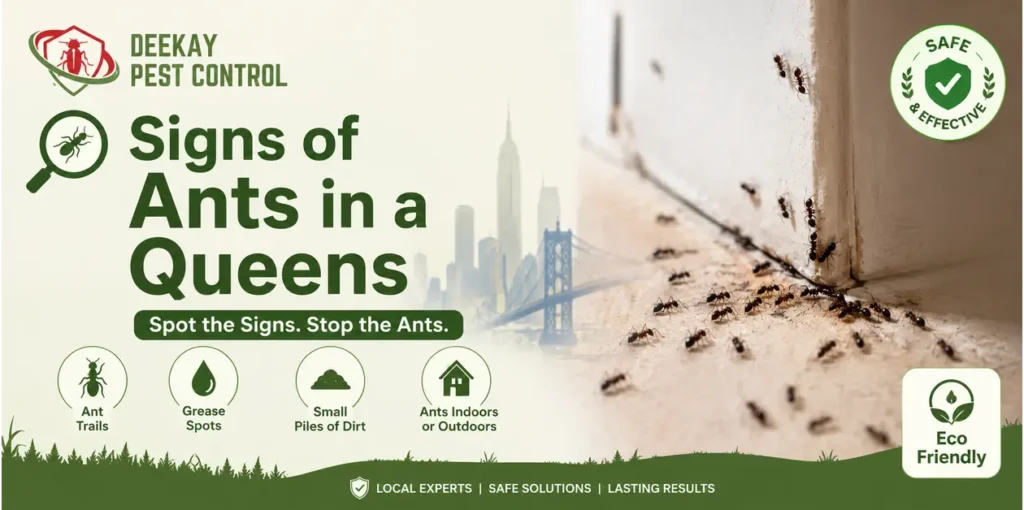
Recognizing ant infestation signs early can prevent a small trail from turning into a full colony inside your walls. Property owners and tenants should watch for the following warning signs:
- Visible ant trails along baseboards, countertops, or window sills, especially in the early morning or evening
- Small piles of dirt, wood shavings, or debris near wall cracks, door frames, or wooden structures
- A faint musty or rotten-coconut-like odor when ants are crushed near kitchen counters
- Discarded wings near windowsills or light fixtures, which can indicate a swarming event
- Rustling sounds inside walls, particularly at night when the building is quiet
- Ants appearing suddenly in bathrooms or near water sources after rainfall
- Grease or food residue trails leading from a wall gap toward a food storage area
If any of these signs appear repeatedly rather than as a one-time occurrence, it’s a strong indicator that a colony has already established itself somewhere in the structure.
Sugar Ants Queens Apartment Problems
Apartment living in Queens comes with its own unique pest challenges, and sugar ants Queens apartment infestations are among the most frequently reported issues by tenants. These ants are drawn to spilled juice, soda residue, cereal crumbs, and even pet food left out overnight. Because apartment units share walls and plumbing lines with neighboring units, an infestation in one apartment can quickly spread throughout an entire floor or building.
Tenants often notice a thin line of ants moving along kitchen counters or bathroom tile, particularly near sink drains. Because these ants nest in small, hard-to-reach voids, simply wiping up a visible trail rarely solves the underlying problem, since the colony itself remains untouched behind the wall.
Pavement Ants and Carpenter Ants Queens: Outdoor vs. Structural Damage
Two very different ant species cause two very different types of problems for Queens properties. Pavement ants Queens homeowners typically see are small, dark brown ants that nest under sidewalk slabs, driveways, and building foundations. While mostly a nuisance rather than a structural threat, large colonies can occasionally push through foundation cracks and enter basements or ground-floor units in search of food.
Carpenter ants Queens property owners should take far more seriously. Unlike pavement ants, carpenter ants tunnel through moisture-damaged or decaying wood to build their nests, which means their presence often signals an existing water leak or structural vulnerability. Left unaddressed, carpenter ant colonies can weaken support beams, door frames, and wooden flooring over time, leading to costly repairs well beyond standard pest control.
Odorous House Ant NYC: The Sugar Ant Smell Test
One of the easiest ways to confirm an ant identification without professional equipment is a simple sugar ant smell test. The odorous house ant NYC residents encounter releases a distinct rotten-coconut or blue-cheese-like smell when crushed, which is where its nickname comes from. This species is especially common in kitchens and bathrooms, nesting behind wall voids, under flooring, and near hot water pipes and heaters.
To perform the test, gently crush one of the ants found trailing near a food or water source using a tissue or paper towel. A noticeably unpleasant, musty odor confirms the species and helps property managers rule out other ant types before scheduling treatment.
Pharaoh Ant Queens High-Rise Infestations
High-rise buildings present a unique set of challenges, and Pharaoh ant Queens high-rise infestations are becoming an increasingly common complaint among building managers and tenants alike. These pale yellow, nearly translucent ants are extremely small, making them easy to overlook until their population has already multiplied significantly.
What makes Pharaoh ants particularly difficult to manage is their tendency to split into multiple smaller colonies when disturbed, a behavior known as “budding.” This means that improper treatment, such as using over-the-counter sprays, can actually make the infestation worse by scattering the colony throughout the building’s plumbing chases, electrical conduits, and shared wall systems. Professional intervention is almost always required to fully resolve a Pharaoh ant problem in multi-unit buildings.
How to Identify an Ant Nest on Your Property
Successful ant nest identification requires checking both indoor and outdoor areas where moisture, warmth, and food sources overlap. Outdoors, look for small mounds of loose soil near sidewalk cracks, foundation edges, or garden beds. Indoors, check behind kitchen appliances, under sinks, inside wall voids near plumbing, and around window and door frames where wood may have softened from moisture exposure.
A helpful method for narrowing down a nest location is to place a small amount of bait, such as a drop of honey or a piece of protein, near an active trail and observe which direction the ants travel after feeding. This can help pinpoint whether the colony is nesting inside a wall, under flooring, or outside near the foundation, which is valuable information before any treatment begins.
It’s also worth noting that some colonies maintain multiple satellite nests connected to a single main colony, particularly in larger residential buildings or commercial properties with extensive plumbing and electrical infrastructure. This means that even after locating one active trail, ants may still be entering from a completely different point on the property. For this reason, a thorough inspection typically involves checking several potential entry areas at once, including exterior wall gaps, utility line penetrations, roofline vents, and any areas where previous water damage may have gone unrepaired.
Landlord Pest Responsibility NYC and Queens Ant Treatment Cost
Understanding landlord pest responsibility NYC regulations is essential for both tenants and property owners. Under New York City housing codes, landlords are generally required to maintain rental units in a pest-free, habitable condition, which includes addressing ant infestations that affect livability. Tenants who report ant problems should document the issue with photos and written communication to their landlord or management company, as this creates a paper trail if further action is needed.
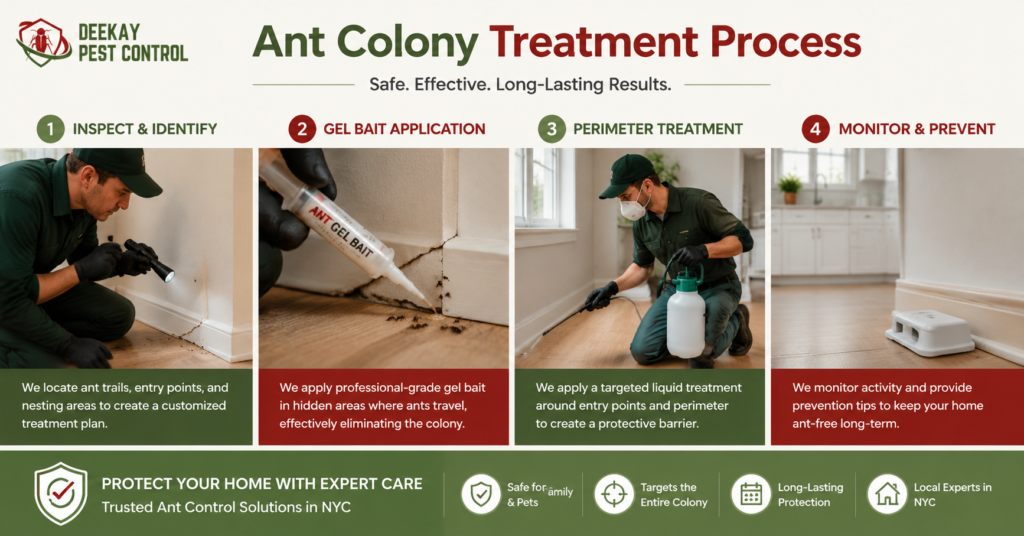
Once a species has been confirmed, most ant control Queens providers will recommend a targeted baiting or barrier treatment rather than a one-size-fits-all spray, since different species respond to different bait formulas. For property owners scheduling treatment, Queens ant treatment cost varies depending on the severity of the infestation, the ant species involved, and the size of the property. A single-unit treatment for a minor sugar ant or pavement ant problem is typically far less expensive than treating a multi-floor carpenter ant or Pharaoh ant infestation that requires ongoing monitoring. Most professional providers offer an initial inspection to assess the scope of the problem before providing an accurate quote, which helps avoid unnecessary spending on treatments that don’t match the actual infestation type.
Working with a licensed provider for Ant Control Queens, NY ensures that the correct species-specific treatment is applied, rather than relying on generic store-bought products that often fail to reach the nest itself. For properties dealing with multiple pest issues beyond ants, a broader Pest Control Queens NY service plan can address rodents, roaches, and seasonal pests alongside ant colonies, offering a more complete long-term solution for both residential and commercial buildings.
Frequently Asked Questions
1. How do I know if I have a small ant problem or a full infestation? A small, occasional trail near an open food container is usually minor and can often be resolved by cleaning and sealing entry points. However, if ants reappear daily, come from multiple directions, or you notice discarded wings, it likely indicates an established colony that needs professional attention.
2. Can I get rid of carpenter ants without addressing the water damage first? Not effectively. Since carpenter ants are drawn to moisture-damaged wood, treating the ants alone without repairing the underlying leak or moisture source usually results in the colony returning within a short period.
3. Are the ants in my apartment my responsibility or my landlord’s? In most cases, ongoing pest control in shared or multi-unit buildings falls under the landlord’s maintenance obligations, especially if the infestation originates from a shared wall, plumbing line, or building-wide issue rather than tenant negligence.
4. Why do ants keep coming back even after I clean the area? Cleaning removes the visible trail and food source, but the actual nest remains untouched behind walls or under flooring. Until the colony itself is treated at its source, worker ants will continue returning to search for food.
5. Is it safe to use store-bought ant spray in an apartment building? Store-bought sprays can sometimes scatter certain ant species, particularly Pharaoh ants, causing the colony to split and spread into new areas rather than being eliminated. Professional treatment is generally more reliable for multi-unit buildings.
6. How long does professional ant treatment typically take to work? Most treatments show a noticeable reduction in ant activity within one to two weeks, though full colony elimination can take slightly longer depending on the species, nest location, and severity of the infestation.
Final Thoughts
Recognizing the signs of ants in a Queens home or business early makes a significant difference in how quickly and affordably the problem can be resolved. From sugar ants in shared apartment buildings to carpenter ants signaling hidden moisture damage, each species requires a slightly different approach to treatment. Property owners and tenants who act on early warning signs, document infestations properly, and work with experienced local professionals are far more likely to achieve a long-term solution rather than a temporary fix.